Last Updated: July 31, 2026
Desert bighorn sheep are one of the most thrilling wildlife encounters in the American Southwest. Found throughout rugged canyon country from western North America to northern Mexico and Baja California, these remarkable animals have evolved to thrive in terrain that seems almost impossibly steep. We love photographing them because they occupy dramatic rocky ledges with sweeping desert backdrops, are surprisingly tolerant of patient observers with long lenses, and their massive curling horns make for extraordinary portraits. Zion National Park in southwestern Utah is one of the best places in the country to find them — and on this January 2021 visit, we had an encounter we will never forget.

Visitor Information: Zion National Park is located at 1 Zion Park Blvd, Springdale, UT 84767. Hours: The park is open 24 hours a day, 365 days a year; the main visitor center typically operates 8:00 AM–5:00 PM (hours vary seasonally — check current hours before your visit). Admission: $35 per vehicle (7-day pass), $30 per motorcycle, $20 per person on foot or bicycle. America the Beautiful annual passes are accepted. Phone: (435) 772-3256. Website: nps.gov/zion.
Zion National Park, Utah

Zion is consistently among the top four most visited national parks in the United States, drawing over four million visitors annually — and it earns every one of them. Great Smoky Mountains National Park is the most visited, and we noticed just how crowded it can get when we were there. Zion’s main canyon is served by a free shuttle system from spring through fall, as private vehicles are not permitted on the Zion Canyon Scenic Drive during peak season. This shuttle system actually enhances the experience — you hop on and off at trailheads without worrying about parking, and the absence of traffic noise lets the canyon feel as wild as it truly is.


The canyon walls that define Zion’s visual identity are composed of Navajo Sandstone, a formation deposited as ancient sand dunes roughly 190 million years ago during the Jurassic period. Iron oxide and manganese minerals in the rock create the striking reds, oranges, and creamy whites that glow brilliantly in afternoon light. Some of the canyon walls rise nearly 3,000 feet above the valley floor, giving Zion a scale that photographs can barely capture.

The canyon itself was carved by erosion from the North Fork of the Virgin River, a process that continues today. The river is deceptively powerful — flash floods can race through Zion Canyon with little warning, and hikers entering the famous Narrows slot canyon should always check weather conditions upstream before heading in. The water and its tributaries also sustain lush riparian vegetation, including the Fremont cottonwoods that trace the river’s course across the valley floor.


In late October and early November, the valley comes alive as Fremont cottonwoods turn brilliant yellow and gold. Because the cottonwoods grow wherever water is close to the surface, their fall color traces the course of the river and its tributaries in vivid lines against the red canyon walls. It is one of the most photogenic natural contrasts in the entire American Southwest.

Mule deer are a regular sight in the valley, grazing calmly near the river as hikers pass. Zion is a hiker’s paradise — Angels Landing (a permit-required, chain-assisted climb to a dramatic exposed summit at 5,790 feet) and the Narrows (a slot canyon trek through the Virgin River itself) draw visitors from around the world. The park offers trails ranging from easy riverside walks to technical scrambles, making it accessible to every level of hiker.
Desert Bighorn Sheep

Desert bighorn sheep are smaller and more lightly built than their Rocky Mountain counterparts, adapted for the extreme heat and sparse water of canyon country. But they are no less impressive — watching them move across near-vertical rock faces with casual ease is one of those wildlife experiences that never gets old no matter how many times you see it.
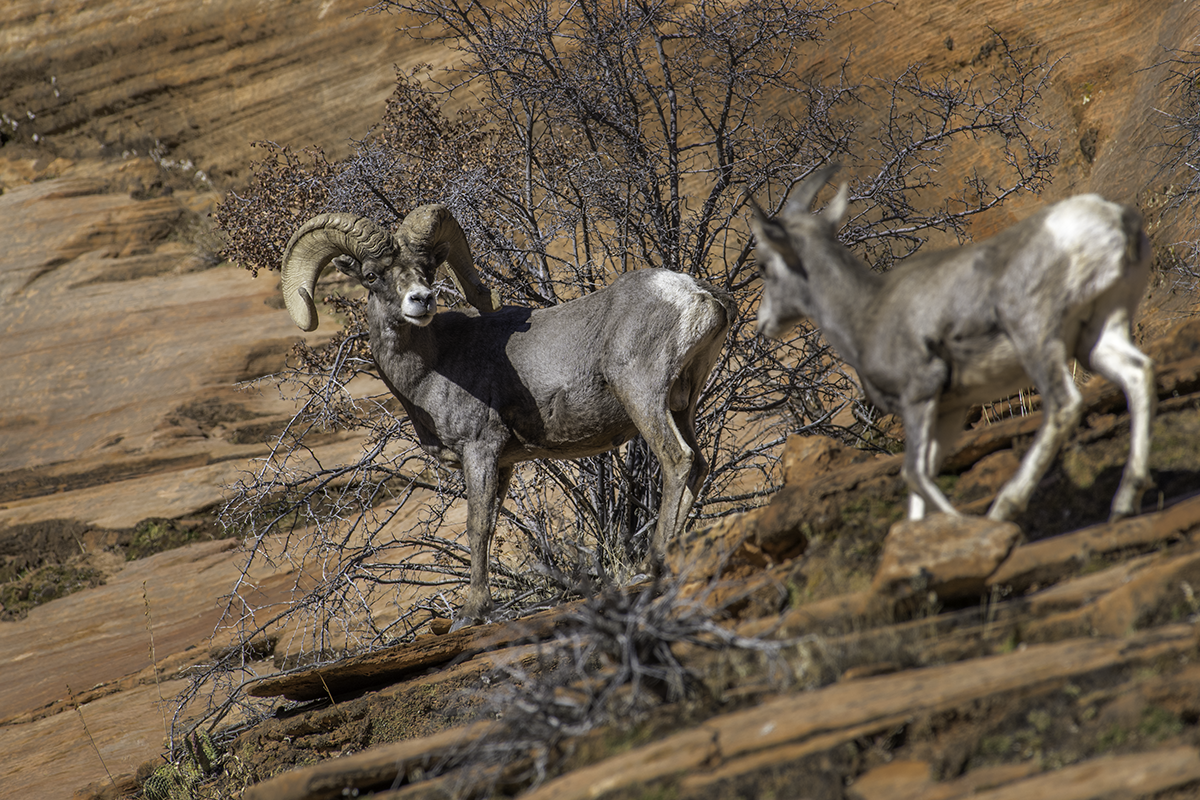
On this visit we had an extraordinary front-row seat to a wildlife management operation: a team of researchers was in the field tranquilizing one of the sheep for radio collar fitting and biological measurements. Watching the careful, purposeful work of the biologists — the animal gently sedated, measured, collared, and safely recovered — was a rare and genuinely moving experience that reminded us how much dedicated work goes into protecting these animals.

The researchers shared some genuinely encouraging news: the desert bighorn sheep population at Zion is healthy and growing. The sheep were locally extinct by the 1960s, lost to hunting pressure and disease transmitted from domestic livestock. In 1978, fourteen desert bighorn sheep were reintroduced into Zion National Park — a small and fragile founding population. Today, that group has grown to over 500 individuals. It is one of the great conservation success stories of the modern National Park system.

Desert bighorn sheep are social animals, typically forming groups of 8 to 10 individuals, though larger aggregations can occur during the rut (breeding season runs roughly July through December for desert bighorn). Rams and ewes generally live separately for much of the year, coming together primarily during the rut, when rams compete intensely for breeding rights with skull-cracking clashes that can be heard from a considerable distance.

These animals are stocky and roughly the size of a mule deer. Both rams and ewes carry horns — the rams’ massive curling horns can weigh more than 30 pounds, a remarkable proportion of total body weight. Desert bighorn have extraordinary physiological adaptations for their arid environment: they can go extended periods without drinking water, losing up to 30 percent of their body weight in the process, and then rapidly rehydrate at the next available water source. Because they can exploit desert terrain that would eliminate other large mammals, they face relatively few natural predators — though mountain lions, coyotes, and bobcats do take occasional individuals.


The sheep are concentrated in the southeastern section of the park and are most reliably spotted near the Checkerboard Mesa area along the east entrance road. Checkerboard Mesa itself is one of Zion’s most distinctive geological features — a massive dome of Navajo Sandstone scored with a grid of vertical and horizontal cracks that create a striking checkerboard pattern across its surface. The vertical fractures formed as the rock layers were deposited; the horizontal ones opened as overlying rock eroded away and pressure was released. Even without the sheep, the east entrance road is worth a slow drive for the geology alone. Despite the deep snowpack we had just seen at Bryce Canyon, there was barely any snow here at the lower elevation of Zion’s east entrance.


Just outside the eastern park entrance, bison grazed on the open rangeland and a hawk watched the highway from a fence post. We have made numerous visits to the Zion area over the years and always come away with something new — a different season’s light, a different animal encounter, a different angle on these ancient canyon walls. We are profoundly grateful for the generations who had the foresight to protect places like this, preserving vast tracts of wilderness so they remain exactly as they were. Thank you, Rocky.
Practical Tips for Visiting Zion National Park
Getting around the park: From spring through fall, private vehicles are not permitted on the Zion Canyon Scenic Drive. A free park shuttle runs frequently and stops at all major trailheads — it is actually more convenient than driving, and the absence of traffic makes the canyon feel genuinely wild. From December through March, you can drive the scenic road yourself.
Finding bighorn sheep: Head to the east side of the park near Checkerboard Mesa, along Highway 9 between the east park entrance and the Zion-Mount Carmel Tunnel. Early morning and late afternoon are the best times. Pull off at scenic viewpoints and scan the rocky slopes above the road — the sheep are often visible from your vehicle. Bring a telephoto lens; they are usually at a distance on the cliff faces.
Hiking permits: Angels Landing now requires a permit obtained through a competitive lottery at recreation.gov. Apply well in advance — walk-up permits are sometimes available the day prior but competition is fierce. The Narrows (bottom-up approach from the Riverside Walk) does not require a permit, but always check river flow and upstream weather conditions before entering. Flash flood risk in slot canyons is real and moves fast.
Best time to visit: Spring (March through May) brings wildflowers and moderate canyon temperatures. Fall (October through November) delivers the famous cottonwood foliage color. Winter is the least crowded season and the canyon light is extraordinary, though higher-elevation trails may have snow and ice. Summer is extremely hot in the canyon and very crowded — if you must visit in summer, be on the trail before sunrise.
Large RVs and tall vehicles: Vehicles over 11 feet 4 inches tall cannot proceed independently past the visitor center due to the Zion-Mount Carmel Tunnel on the east entrance road — tunnel transit requires a special escort with convoy timing. Check the NPS website for current procedures and hours before planning your approach. RV parking in Springdale (just outside the south entrance) is available at several commercial campgrounds.
Frequently Asked Questions
Where is the best place to see bighorn sheep in Zion National Park? The desert bighorn sheep are most reliably found in the southeastern section of the park, particularly near Checkerboard Mesa along Highway 9 between the east entrance and the Zion-Mount Carmel Tunnel. Pull over at viewpoints and scan the rocky slopes above — the sheep are often visible from the road, especially in early morning and late afternoon when they are most active.
What is Zion National Park most famous for? Zion is best known for its dramatic Navajo Sandstone canyon walls, the Virgin River slot canyon known as the Narrows, and the Angels Landing hike — one of the most iconic and exposed summit trails in the U.S. national park system. It is also one of the best places in the Southwest to see desert bighorn sheep, mule deer, California condors (in the nearby region), and a stunning display of Fremont cottonwood fall foliage.
Do I need a permit to hike Angels Landing? Yes — Angels Landing now requires a permit obtained through a competitive lottery system at recreation.gov. The permit lottery opens months in advance for peak season dates. Limited walk-up permits are sometimes available the day before, but demand is extremely high. The trail itself involves chain-assisted climbing on a narrow exposed ridge and is not recommended for those with a fear of heights.
What is Checkerboard Mesa in Zion National Park? Checkerboard Mesa is a large dome of Navajo Sandstone near the park’s east entrance covered in a distinctive grid of vertical and horizontal cracks that create an unmistakable checkerboard pattern across its surface. The vertical fractures formed during rock deposition, and the horizontal ones developed as overlying rock eroded away and released internal pressure. The mesa is also the primary habitat for Zion’s thriving population of desert bighorn sheep.
How were Zion’s desert bighorn sheep saved from extinction? Desert bighorn sheep were locally extinct in Zion by the 1960s, lost to hunting pressure and disease transmitted by domestic livestock grazing in the area. In 1978, the National Park Service reintroduced 14 desert bighorn sheep into the park. That small founding population has grown to over 500 individuals today — one of the most successful large mammal reintroduction programs in the history of the U.S. National Park system.