Last Updated: May 2, 2026
Driving across northern Arizona on I-40 — the modern descendant of old Route 66 — it’s easy to treat Petrified Forest National Park as a quick roadside stop between bigger destinations. That would be a mistake. This park, which encompasses both the Painted Desert and one of the world’s largest concentrations of petrified wood, is one of the most geologically and archaeologically extraordinary places we’ve visited anywhere in the American Southwest. We came through in October traveling between Canyon de Chelly and Winslow, and we wished we’d budgeted more time. The park deserves a full day — ideally two.

The Painted Desert

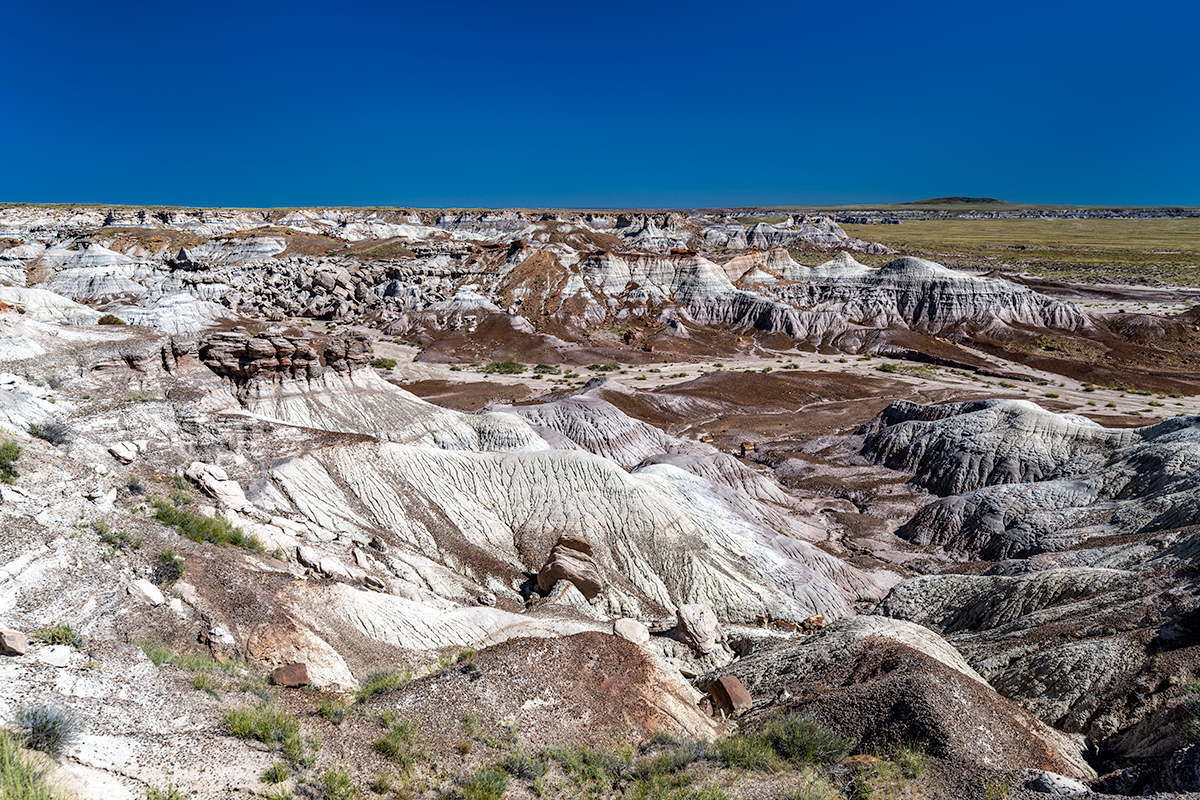
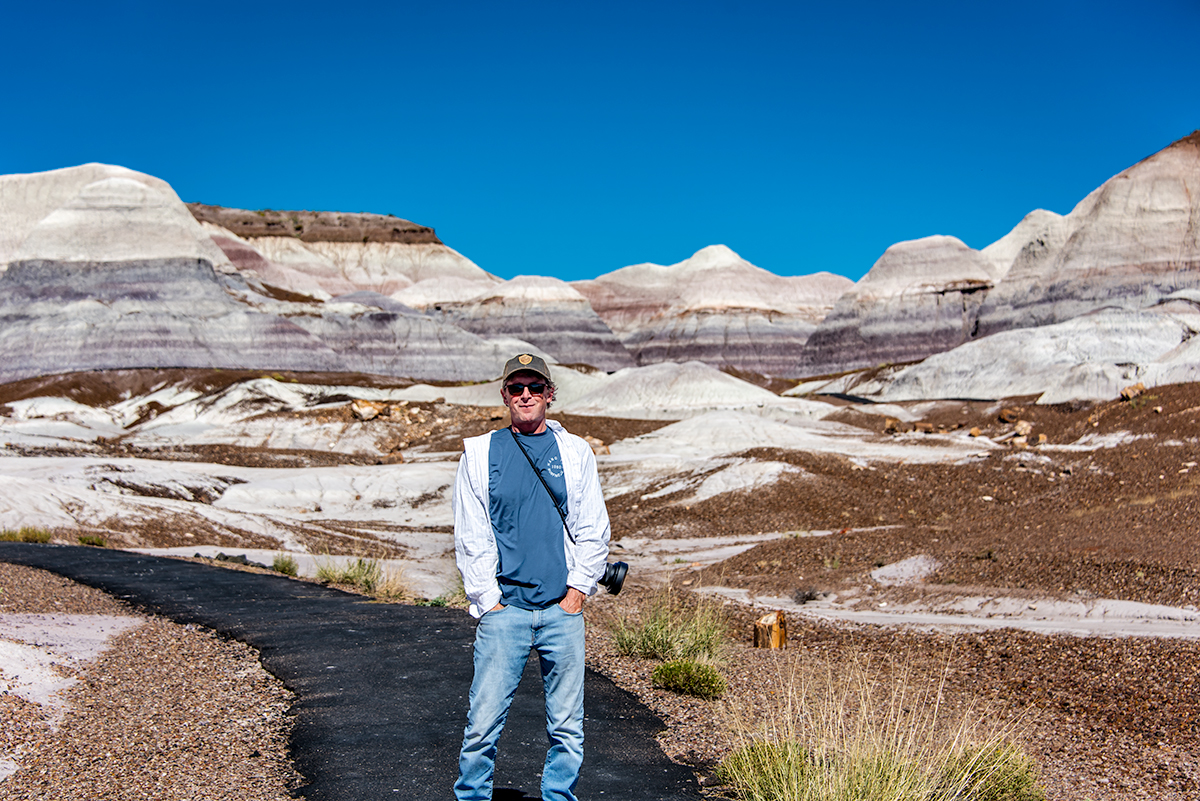
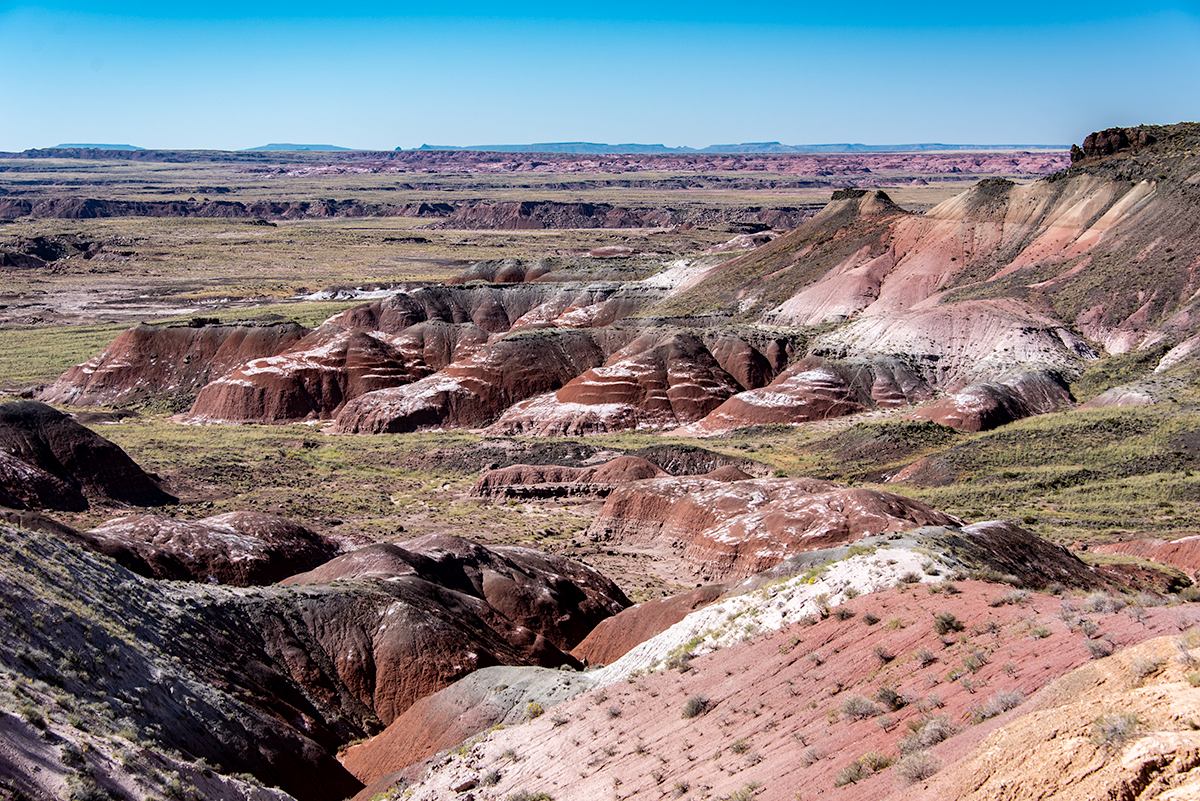
The Painted Desert is the northern portion of Petrified Forest National Park, and it earns its name completely. The landscape here is a series of eroded badland hills — the Arizona Badlands — banded in layers of red, purple, pink, orange, blue-gray, and gold that shift in intensity with the angle of the sun. At an elevation of 5,436 feet on the Colorado Plateau, the terrain is semi-desert shrub grassland: wide open, windswept, and hauntingly beautiful.
The colors aren’t painted on — they’re geological. Alternating layers of claystone, siltstone, and mudstone contain varying concentrations of iron, aluminum, hematite, and manganese. Each mineral produces a different color when oxidized: iron oxides create the reds and oranges, manganese produces purples and blues, and the pale layers are relatively mineral-poor. The result is a landscape that looks like a watercolor painting viewed from 500 feet up — and from ground level, it’s even more striking.

It was October when we visited — not peak wildflower season — but a few yellow flowers persisted among the dry grasses. More excitingly, we spotted pronghorn antelope grazing on the open plateau. Having seen them earlier in our trip near Sonoita, it was wonderful to encounter them again in a completely different landscape — a reminder of how broadly these remarkable animals once ranged across the American West.


The Painted Desert section of the park has several overlooks accessible by car along the north entrance road, and multiple trails that take you down into the badlands themselves. Getting off the pavement and walking among the formations is a completely different experience from the overlooks — you’re surrounded by color on all sides, and the silence is profound.





Petrified Forest: 225 Million Years in the Making

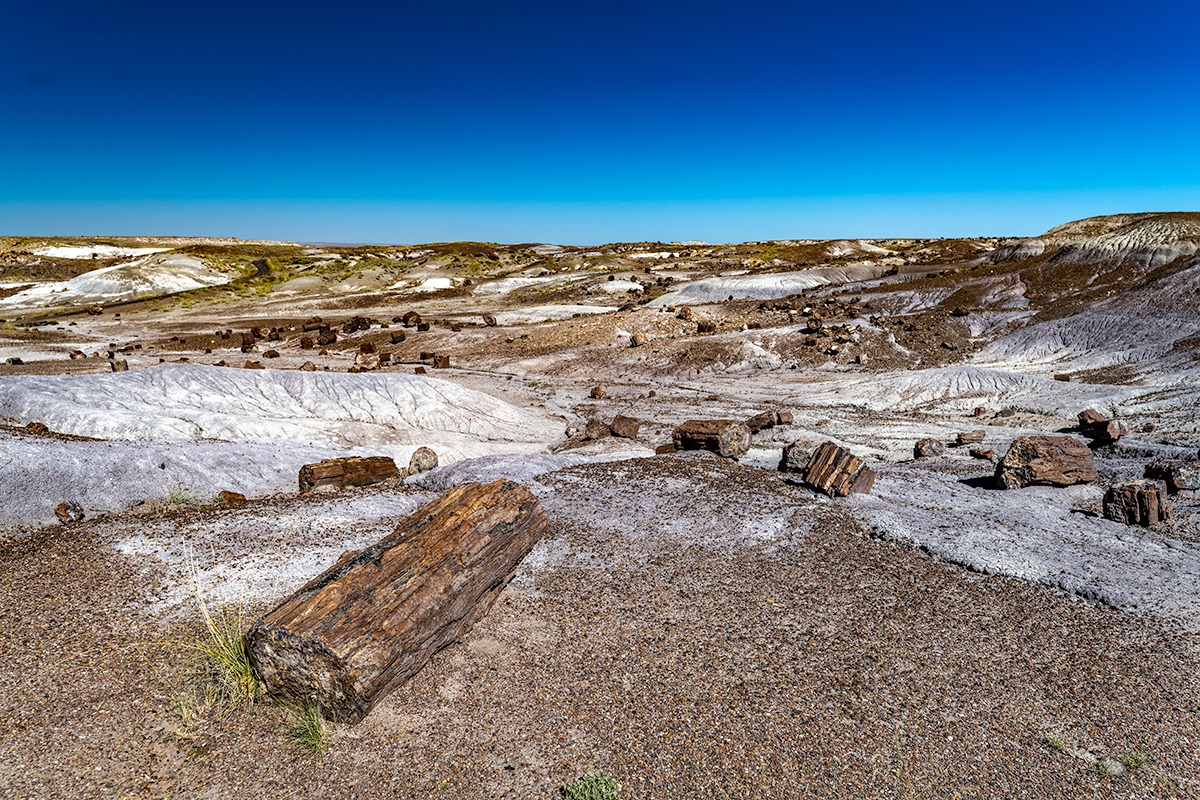
The southern half of the park is where the petrified wood takes center stage — and it is genuinely one of the most remarkable things we’ve seen anywhere. Approximately 225 million years ago, during the Late Triassic period, this region was a vast tropical forest near the equator, crossed by rivers and populated by giant conifer trees, dinosaurs, and early crocodilian reptiles. When trees fell, they were buried under river sediment before they could decompose. Over millions of years, groundwater carrying dissolved silica and minerals slowly replaced the wood cells with quartz crystal — a process called silicification. The result is logs that look exactly like fallen trees but are solid, brilliantly colored stone.
Over time, the tectonic plate carrying this landscape migrated north — the region is now at roughly 35° latitude rather than near the equator. The Colorado Plateau gradually lifted, and millions of years of erosion by wind and water exposed the buried logs, leaving them scattered across the desert surface as though a forest simply turned to stone overnight.


The park is sometimes called the Crystal Forest — and when you see the logs up close, you understand why immediately. The cross-sections reveal brilliant amethyst purples, deep reds, honey yellows, and pure whites — the colors determined by which trace minerals were present when silicification occurred. Iron produced reds and yellows; manganese created purples and blacks; pure silica gave the white and gray tones. We’ve hiked in other parks where a sign said “petrified rock here” and we squinted at something that looked, honestly, like a rock. Here there is no ambiguity. These look exactly like fallen tree trunks — complete with preserved bark texture, growth rings, and branch scars — but they ring like stone when tapped and weigh hundreds of pounds per foot.




One of the things we appreciated most about this park: all trails are dog-friendly — a genuine rarity in the National Park system. Jake could walk every trail with us, which made the visit significantly more enjoyable. The park also has very manageable crowds — plenty of parking at every trailhead, short lines at overlooks, and frequent stretches of trail where we had the petrified logs entirely to ourselves.
Ancestral Puebloan Petroglyphs


The petrified wood and painted badlands aren’t the only ancient things in this park. Ancestral Puebloan people lived in this region from roughly 650 to 1400 CE, and they left behind an extraordinary record of their presence in the form of petroglyphs — images carved into the dark desert varnish on rock surfaces. The most accessible concentration is at Newspaper Rock, where over 650 individual glyphs cover a single large sandstone surface: human figures, animals, spirals, geometric patterns, and symbols whose meanings we can only guess at. Standing in front of Newspaper Rock and understanding that people carved these images here over a thousand years ago — while walking among trees that had already been stone for 200 million years — creates a layered sense of time that is genuinely hard to process.
Holbrook, Arizona & Route 66


The nearest town to Petrified Forest National Park is Holbrook — a classic Route 66 town on I-40 in northeastern Arizona. Established in 1882 as a railroad camp, Holbrook has the faded-but-proud character of many towns along the original Mother Road. Route 66 was established in 1926 and ran 2,448 miles from Chicago to Los Angeles, passing directly through Holbrook and alongside what is now the national park. The road was decommissioned in 1985 when the interstate highway system made it obsolete, but its cultural legacy — immortalized in John Steinbeck’s The Grapes of Wrath, countless road trips, and the imagination of generations of American travelers — lives on in towns like this one.
Near Holbrook there’s a small roadside stop honoring the original Route 66 alignment through the Painted Desert — worth a quick stop for the photo and the nostalgia. The old road ran right through land that is now part of the national park, and you can almost feel the ghosts of mid-century road trippers who passed through here before the interstate pulled the traffic away.
A note on Holbrook RV parks: We stayed at the OK RV Park in Holbrook — 50-amp electric, decent water pressure, and sewer, but poor internet. The sites are extremely tight and we encountered goat head stickers everywhere (sharp thorns that find shoes, paws, and tires with equal enthusiasm). We wouldn’t return except as an overnight pass-through. If you have flexibility, Winslow to the west has better options.
Petrified Forest National Park Visitor Information
Petrified Forest National Park is located in northeastern Arizona, straddling I-40 approximately 25 miles east of Holbrook. The park has two entrances: the north entrance off I-40 (Exit 311) near the Painted Desert Visitor Center, and the south entrance off US-180 near the Rainbow Forest Museum. The 28-mile park road connects the two entrances and can be driven in either direction. The park is open daily year-round; hours vary seasonally — check current hours at nps.gov/pefo. The standard National Parks annual pass is accepted. All trails are dog-friendly as long as dogs are kept on a leash — one of the very few national parks with this policy.
Practical Tips for Visiting Painted Desert & Petrified Forest
Drive the full park road — don’t just stop at one end. The north entrance showcases the Painted Desert; the south end has the densest concentrations of petrified wood and the Crystal Forest trail. The full 28-mile drive takes about 2–3 hours with stops. Get off the pavement — the overlooks are impressive but walking among the formations is a completely different experience. Most trails are short and easy. Best light is early morning or late afternoon — the mineral colors in both the badlands and the petrified wood are dramatically enhanced by low-angle light. Midday sun washes out the colors. Do not take petrified wood — it is a federal offense and the park takes it seriously. Remarkably, the park receives hundreds of packages of returned wood every year from guilty former visitors. Bring water and sunscreen — shade is essentially nonexistent. Dogs are welcome on all trails on leash — one of the best pet-friendly national parks in the system.
Frequently Asked Questions About Petrified Forest National Park
How long does it take to visit Petrified Forest National Park? A minimum of 3–4 hours covers the main stops along the park road. A full day allows you to hike several trails, spend real time in the Painted Desert, and explore the Crystal Forest and Newspaper Rock petroglyphs properly. We wished we’d had more time.
Is Petrified Forest National Park worth visiting? Absolutely — especially if you’re passing through on I-40. The combination of Painted Desert badlands, ancient petrified logs, and Ancestral Puebloan petroglyphs in one park is extraordinary, and the crowds are a fraction of what you’d find at Zion, the Grand Canyon, or Arches.
Can you take petrified wood from Petrified Forest National Park? No — removing any natural or cultural object from the park is a federal offense. The park estimates that several tons of petrified wood are stolen each year, which is why you’re now allowed to purchase legally obtained petrified wood at the park gift shops and in Holbrook.
Are dogs allowed at Petrified Forest National Park? Yes — and this is one of the few national parks where dogs are welcome on all trails (on leash). This is a genuine rarity and a major plus for traveling pet owners.
What is the best time of year to visit? Spring (April–May) and fall (September–October) offer the most comfortable temperatures and the best photography light. Summer is hot but manageable given the elevation. Winter can bring snow, which creates a spectacular contrast with the colorful badlands — and virtually no other visitors.
How far is Petrified Forest from the Grand Canyon? The South Rim of the Grand Canyon is approximately 120 miles west of the park — about a 2-hour drive. Petrified Forest pairs well with Canyon de Chelly (90 miles northwest) as part of a northeastern Arizona loop.
Have you visited the Painted Desert or Petrified Forest? We’d love to hear what trails you hiked and what surprised you most — drop a comment below!