Last Updated: May 3, 2026
One of the great pleasures of a spring stay in Tucson, Arizona is the cactus bloom — and the species don’t all flower at once. The bloom moves through the Sonoran Desert in a predictable cascade from March through June: hedgehog cactus first in March, pincushion cactus next as March turns into April, then barrel cactus, prickly pear, and cholla through April, and finally the iconic saguaro reaching peak bloom in May. We left Tucson at the very beginning of April this year, which meant we caught the hedgehogs at their absolute peak, the claret cups in red flame, and the larger barrel and saguaro cacti just beginning to bud — the season was about to truly explode behind us as we drove west. As a longtime photographer of the Sonoran Desert, Michael structures spring stays specifically around this bloom calendar.

Hedgehog Cactus

The hedgehog cactus (genus Echinocereus) is one of the very first Sonoran Desert cacti to bloom each year, often pushing its first flowers in early March. The genus is large — over 70 species across the southwestern US and Mexico — and the flowers come in an impressive range of colors: bright magenta, rose pink, sunny yellow, even pale lavender. The blooms are trumpet-shaped, with wide flaring petals at the end designed to attract the bees, hummingbirds, and other insect pollinators that the species depends on. Engelmann’s hedgehog cactus, one of the most common Tucson-area species, produces flowers up to 3 inches across — a remarkable size for a cactus that itself rarely exceeds the dimensions of a baseball.


After successful pollination, the hedgehog cactus flower transforms into a fleshy fruit. Unlike the smooth fruits of many cacti, hedgehog cactus fruits stay true to the genus name — they are typically covered in small spines, similar to the cactus body itself.


Despite the spiny exterior, the flesh of the hedgehog cactus fruit is typically sweet and edible. In some species the taste is reminiscent of strawberries — earning certain hedgehog species the nickname “strawberry cactus.”


The sweet fruit serves a dual evolutionary purpose. It rewards the bees and hummingbirds whose pollination produced it, and it attracts seed-dispersing animals — birds, mammals, lizards — that eat the fruit and deposit the indigestible seeds elsewhere through their droppings. This is one of the cleanest examples of plant-animal mutualism in the Sonoran Desert, and the hedgehog cactus is one of its most successful practitioners.


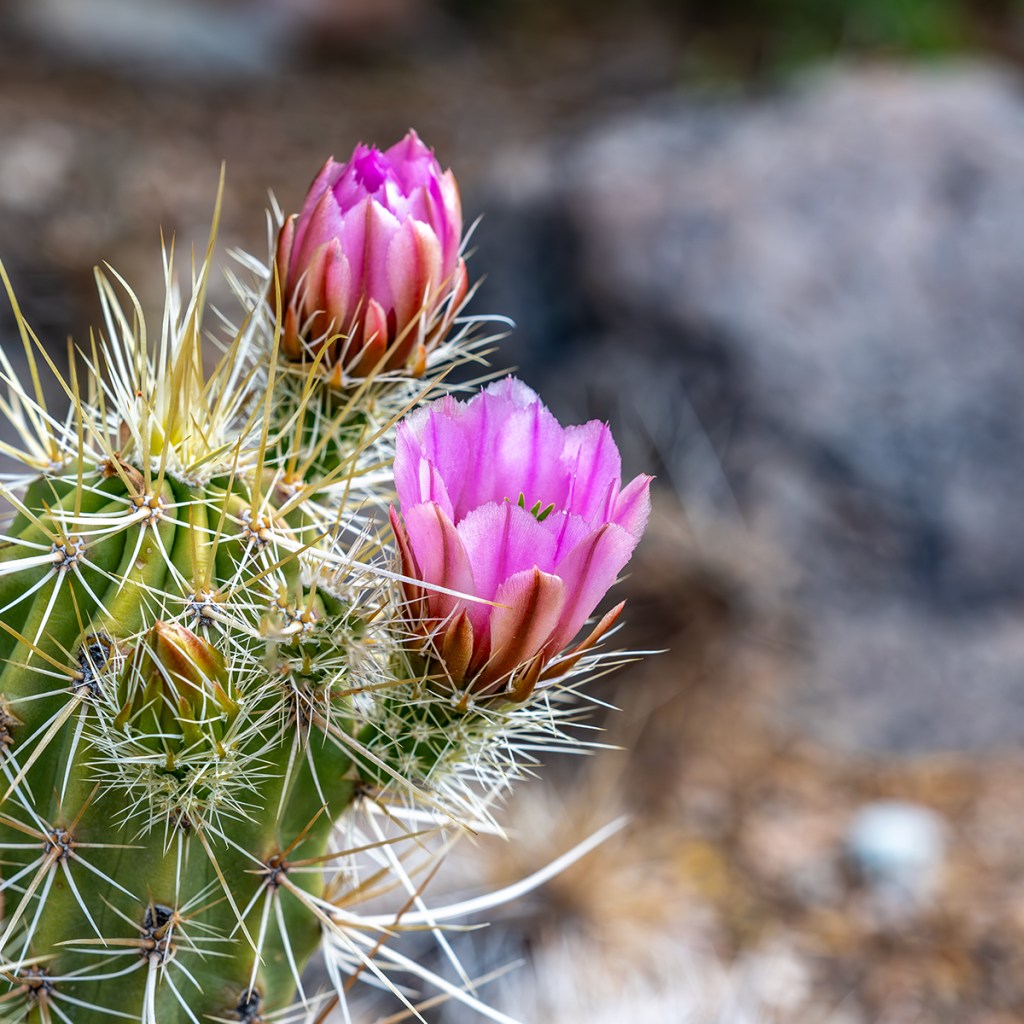

The spines on the fruit of some hedgehog cactus species fall off as the fruit ripens, making it easier for animals — and in some species, indigenous peoples — to handle and consume.


Indigenous peoples of the Sonoran Desert — including the Tohono O’odham and the Akimel O’odham — have used cactus fruits and pads as both food and medicine for thousands of years. Hedgehog fruits, prickly pear pads (nopales), and saguaro fruits all featured in traditional desert food culture, and several of those traditions continue actively today.
Claret Cup Cactus

The claret cup cactus (Echinocereus triglochidiatus) is a low-growing member of the hedgehog cactus genus and one of the most visually striking spring bloomers in the southwestern desert. The plant typically reaches only 1 to 2 feet in height but can form dense clumps of dozens of stems that produce spectacular synchronized flower displays. The species ranges from southern California through Arizona, New Mexico, west Texas, southern Colorado, and northern Mexico — including a thriving population on the North Rim of the Grand Canyon, where Michael has photographed them at the upper edge of their range.

The flowers are trumpet-shaped, brilliant red-orange (with pink and yellow variants in some populations), and tend to cluster at the very top of the stems — creating a kind of natural bouquet effect that is hard to walk past without stopping. Unlike the night-blooming saguaro, claret cup flowers stay open for several days, making them one of the more photographically forgiving species during peak bloom. The deep tubular shape and the bright color combination evolved specifically to attract hummingbirds, which are the species’ primary pollinators in the wild.

The common name perfectly describes the shape and color of the flowers — they really do look like a small wine cup filled with claret.

The species thrives in hot, dry climates with well-drained soils. In the wild it grows in desert scrublands, juniper-pinyon woodlands, and even on rocky slopes at the base of larger plants where some shade and additional moisture collect. We’ve seen claret cups at the base of the Grand Canyon’s North Rim, on the Tucson Mountains’ rocky bajadas, and at the Desert Museum’s cactus gardens — and the species is reliably one of the visual highlights of any spring desert visit.
Big Bertha Torch Cactus (Cultivated)


Big Bertha is a popular cultivated hybrid in the genus Echinopsis (the torch cacti) — related to but distinct from the true hedgehog cactus genus Echinocereus. Echinopsis hybrids like Big Bertha have become favorite ornamental garden cacti throughout the southwestern US for one specific reason: the flowers are spectacular, sometimes 6 to 8 inches across, and they open at dawn for a single brief day before closing forever. Catching one in bloom is a small piece of luck, and we felt privileged to find a Big Bertha at peak that morning.
Pincushion Cactus

Pincushion cactus — genus Mammillaria — is one of the largest and most diverse cactus genera in the Americas, with over 200 recognized species and a strong presence throughout the Sonoran and Chihuahuan deserts. The species are typically small, round or barrel-shaped, and covered in knobby bumps called tubercles, each topped with a cluster of radiating spines. The overall effect — a small green dome studded uniformly with white or pale spine clusters — really does look like a pincushion, which is where the common name comes from. Spine colors vary widely across species: white, yellow, brown, even red. Some species have specialized hooked spines that anchor the plant in soil and even latch onto passing fur to disperse stem fragments to new locations.


Pincushion cacti produce small flowers that emerge from between the tubercles rather than from the apex of the plant — a distinguishing feature that helps separate Mammillaria from the related Echinocereus genus. The flowers are typically arranged in a near-perfect crown ring around the top of the cactus, blooming in pink, yellow, red, or white depending on species. Each individual flower is small (often less than an inch across), but the synchronized ring effect can be remarkably beautiful at close range.
Barrel Cactus


Barrel cacti — primarily genus Ferocactus in southern Arizona, with some species in genus Echinocactus — are aptly named for their characteristic squat barrel-shaped bodies. The round shape minimizes surface area relative to volume, which helps the plant conserve water in the hot, dry Sonoran Desert. The thick fleshy stems store water during the rainy season and release it gradually through long droughts. Barrel cacti are also famously well-protected: dense clusters of long, often curved spines deter herbivores from reaching the water-rich tissue inside. Some species (notably the fishhook barrel cactus Ferocactus wislizeni, common in southern Arizona) have heavy hooked spines that genuinely will snag fur, clothing, or skin.
In spring and early summer barrel cacti produce their flowers at the crown of the plant — a striking ring of color set against the green and the long curved spines. The blooms range from bright yellow and orange through red and even purple depending on species, with the fishhook barrel typically flowering in yellow-orange in early summer.

After pollination the barrel cactus’s flowers give way to small fleshy fruits, often bright yellow or red and clustered at the crown of the plant. These fruits are persistent — they can sit on top of the cactus for months — and serve as an important late-season food resource for desert wildlife when other forage is scarce. Birds, rodents, and javelina all feed on barrel cactus fruit, dispersing the seeds in the process.


And there are always a few species we couldn’t confidently identify in the field — the Sonoran Desert holds dozens of cactus species and the smaller, less iconic ones are easy to miss or mistake. Part of what makes the Desert Museum and the various botanical gardens so valuable is the labeled cultivated specimens that let you put species names to plants you’ve been photographing in the wild for years.
Practical Tips for Photographing the Spring Cactus Bloom
Bloom calendar (Tucson area): Hedgehog cactus mid-to-late March; pincushion cactus late March through April; barrel cactus April through May; prickly pear and cholla April through May; saguaro May through early June. The whole sequence runs about ten to twelve weeks. Best time of day: Early morning is the magic window — many cactus flowers open at dawn and stay open through midday, with peak photographic light in the first three hours after sunrise. Best locations: The Tucson Mountain Park trails and Saguaro National Park West for wild specimens, the Arizona-Sonora Desert Museum’s labeled cactus gardens for up-close identification, and the Tucson Botanical Gardens downtown for cultivated rarities. Equipment: A macro lens (60mm or 100mm) is ideal for close-ups, but most modern phone cameras handle the bloom beautifully. A small reflector helps fill in shadows on close-ups; a polarizer reduces glare on the petals. Year-to-year variability: The cactus bloom intensity depends heavily on the previous winter’s rainfall — wet winters produce extraordinary years, dry winters produce sparser bloom. Following the Desert Botanical Garden’s annual bloom reports helps with timing decisions. Don’t pick: Most desert cacti are protected by Arizona state law, particularly saguaros. Photograph, observe, and leave them alone.
Frequently Asked Questions About Sonoran Desert Cactus Bloom
When do cactus bloom in Tucson, Arizona? The Sonoran Desert cactus bloom runs roughly March through June, with different species flowering in a predictable sequence: hedgehog cactus first in March, pincushion in late March and April, barrel cactus and prickly pear in April and May, cholla in April and May, and the iconic saguaro reaching peak bloom in May. The exact timing varies year to year based on winter rainfall.
What is the difference between a hedgehog cactus and a claret cup cactus? Claret cup cactus (Echinocereus triglochidiatus) is one specific species within the hedgehog cactus genus Echinocereus. The genus includes about 70 species across the southwestern US and Mexico — claret cup is one of the most widespread and visually distinctive, with its low-clumping growth habit and brilliant red-orange tubular flowers adapted for hummingbird pollination.
What is the difference between hedgehog cactus and torch cactus? Hedgehog cactus (Echinocereus) and torch cactus (Echinopsis) are related but distinct genera, both in the cactus family. Hedgehog cacti are mostly small, North American natives with diurnal flowers in many colors. Torch cacti are mostly South American natives, often larger, frequently bloom at night, and have produced many popular garden hybrids — including the well-known Big Bertha cultivar with its enormous one-day-only flowers.
Why are pincushion cactus flowers arranged in a ring? Pincushion cacti (Mammillaria) produce flowers from the axils between their tubercles rather than from the apex of the plant — and the tubercles directly below the active growing tip are typically the most mature, so all of them produce flowers at roughly the same time. The result is a synchronized ring of flowers around the upper portion of the plant, an arrangement distinctive enough that it’s a useful field-identification clue for separating Mammillaria from related genera.
Are saguaro cactus flowers worth waiting for? Yes — but they take a long time to wait for. Saguaros typically don’t begin flowering until they’re 30 to 35 years old, and they bloom only at night with each individual flower lasting about 24 hours. Peak bloom in southern Arizona is mid- to late May. The flowers are pollinated primarily by lesser long-nosed bats migrating north from Mexico, with secondary daytime pollination by white-winged doves and bees.
Part of our spring 2024 Tucson exploration — pairs naturally with the Tucson Mountains, the Hugh Norris Trail wildflower hike, and the Raptor Free Flight Show.