Last Updated: May 2026
Olden and Skjolden are two small villages on Norway’s western coast, each sitting at the end of a different fjord system north of Bergen. Skjolden occupies a dramatic position at the innermost tip of the Lustrafjorden — a branch of the Sognefjorden, the longest and deepest fjord in Norway — while Olden sits on the southern shore of the Nordfjorden, the country’s sixth longest. Both are surrounded by rugged, cloud-draped mountains with glaciers and waterfalls dropping directly into the valleys below. Neither village is large — Skjolden has around 200 residents, Olden under 900 — but for a cruise passenger, that small scale works in your favor. The scenery is the whole point, and with far fewer crowds than Bergen, you can actually stand still long enough to take it in. We visited both as part of our Baltic cruise aboard the Sky Princess, and found them to be among the most purely beautiful stops of the entire trip.

Skjolden, Norway


Skjolden sits at the very end of the Lustrafjorden, a dramatic inner arm of the Sognefjorden — Norway’s longest fjord at 204 kilometers (127 miles) and also its deepest, plunging to 1,308 meters at its lowest point. Arriving here by cruise ship is an experience in itself: the fjord narrows as you penetrate deeper into the mountains, the walls rising steeply on both sides until the water ahead seems to simply run out. About 200 people live in Skjolden year-round, which means the village has a grocery store, a small hotel, and very little else — but it has a setting that belongs in landscape paintings.


We were interested in taking the scenic walk to the waterfalls above the village — a route that follows the valley floor with the fjord below and the mountains rising on all sides. There was rain in the forecast, so we brought our rain gear and got away with only light sprinkles. In Norway, always bring rain gear. It almost doesn’t matter what the forecast says. We needed the long walk to work off all the delicious food we had been eating on the ship, and the fresh mountain air was an excellent reminder of why you come to places like this in the first place.


Along the route we passed a couple of small RV parks tucked into the valley with basic hookups — water and electricity — and views that would make most hotel rooms look like a bad deal. Camping in the Norwegian countryside, with a waterfall across the valley and the fjord stretching out below, has to be one of the better ways to spend a night. The wildflowers were in full bloom — it was mid-July and the hedgerows and meadow edges were thick with color.
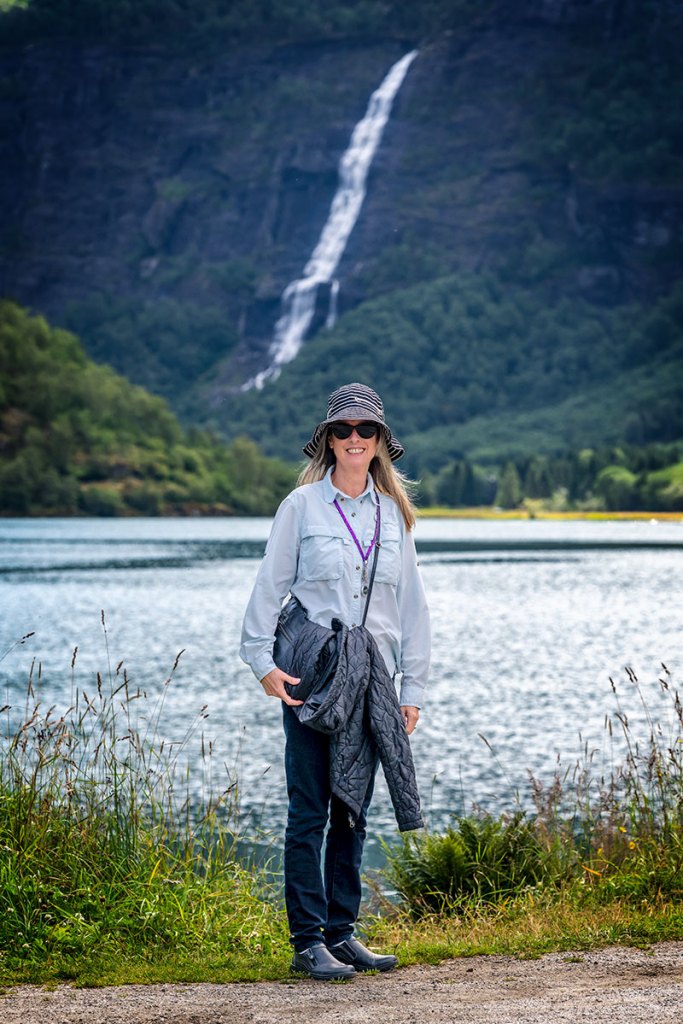

The Åsafossen is the main draw of the walk from Skjolden — a powerful cascade that drops about 590 feet (180 meters) in near-free fall down the mountain face, loud enough to hear from a considerable distance before you can see it. A trail leads to the base where the spray is heavy and the scale of it becomes clear. The sound, the cold mist, and the sheer vertical drop make it one of those waterfalls you stop moving for and just stand in front of for a while.


At the base of the waterfall and in the green meadows stretching away from it, cattle and horses were grazing with total indifference to the scenery. Norwegian farms in fjord country tend to have this quality — a matter-of-fact relationship with surroundings that would stop most visitors in their tracks. The horses were particularly cooperative for photos, coming close enough to inspect us with what appeared to be genuine curiosity.

This view of the Sky Princess from above — the ship looking almost like a toy boat far below in the fjord — gives some sense of the scale of this landscape. When you’re standing at waterfall level looking down, the fjord walls are well over a thousand feet above the water. It’s the kind of perspective that’s impossible to fully convey in photographs and has to be experienced from both directions to really register.
Olden, Norway


Olden sits on the southern shore of the Nordfjorden — the sixth longest fjord in Norway at 106 kilometers — and is noticeably more developed for tourism than Skjolden. The glacier Briksdalsbreen, an arm of the enormous Jostedalsbreen ice field (the largest glacier in continental Europe), is accessible from Olden by bus and draws a steady stream of visitors. The town has a proper tourist infrastructure: souvenir shops, restaurants, and a regular rotation of cruise ships at the dock. Still well under 900 residents, but it has the feel of a place that knows it’s a destination.


We took the Loen Skylift — a cable car that ascends 1,011 meters (3,320 feet) up the near-vertical face of Mount Hoven in about five minutes, one of the most dramatic rides of its kind in Europe — to the alpine area at the top. Unfortunately the mountain summit was buried in cloud, which is part of the Norwegian experience but frustrating when you’ve come for the views. On a clear day you’d see Nordfjorden snaking through the valley far below, the Jostedalsbreen glacier to the east, and snow-capped peaks in every direction. We made do with the walking trails, which were lovely regardless — sheep grazing in the mist, wildflowers in full bloom, and enough altitude to appreciate that we were somewhere genuinely remote even if the panorama was hidden.


Back in Olden we explored the village shops. There were the usual gifts — shirts, hats, key chains, and reindeer pelts — but our favorite were the intentionally ugly trolls. In Norse mythology, trolls are large, hostile creatures that love to deceive and cause trouble for humans; they’re said to turn to stone in sunlight, which is why you don’t find them wandering around during the day. The Norwegian souvenir industry has leaned hard into the troll aesthetic, producing wooden figures ranging from mildly eccentric to genuinely disturbing. We found it completely charming.


Back at village level, the gardens and window boxes of Olden were as carefully tended as anywhere in Norway — which is saying something, because Norwegians take their flowers seriously. The wildflowers around the edge of the village, the old wooden houses, and a small boat sitting still on the Nordfjorden made for a quiet end to a day that had covered a lot of vertical distance. By the time we were back on the ship, both villages had made their case for why the Norwegian fjords deserve every superlative they receive.
Visitor Information
Skjolden is located at the end of the Lustrafjorden in Vestland county, approximately 185 kilometers northeast of Bergen by road. It is accessible by cruise ship — several lines including Princess Cruises stop here on Norwegian fjord and Baltic itineraries — as well as by car, bus, or the Norway in a Nutshell scenic rail and ferry route. The village itself is tiny; the main draw is the surrounding landscape and the walk to Åsafossen waterfall, which begins from the village and follows the valley floor for approximately 3 kilometers each way on a mostly flat, easy path.
Åsafossen Waterfall is reached via a clearly marked trail from Skjolden village. The walk takes approximately 45–60 minutes each way at a comfortable pace. The path is flat and well-maintained, suitable for all fitness levels. There is no admission charge. Bring water and wear waterproof footwear, as the path can be muddy and the spray at the base of the falls is substantial.
Olden is located on the southern shore of the Nordfjorden, approximately 60 kilometers from Stryn and served by regular cruise ship stops from May through September. The town is the main gateway to the Briksdalsbreen glacier — buses run from the harbor to the glacier trailhead (approximately 25 kilometers). The glacier walk itself is about 3 kilometers round trip from the bus drop-off.
Loen Skylift is located in the village of Loen, approximately 5 kilometers from Olden. The cable car ascends Mount Hoven (1,011 meters / 3,320 feet) in approximately 5 minutes. At the top there is a restaurant, a viewing platform, and a network of hiking trails. The skylift operates seasonally from approximately April through October; tickets cost around NOK 395 round trip (approximately $37 USD). Book online in advance during July and August — it sells out regularly on cruise ship days. The return hike down the mountain (Raudmelen trail) takes approximately 2 hours for fit walkers.
Frequently Asked Questions
What makes the Sognefjorden special? The Sognefjorden is the longest fjord in Norway at 204 kilometers (127 miles) and the deepest in the world, plunging to 1,308 meters below sea level. Its inner branches — including the Lustrafjorden where Skjolden sits — penetrate deep into the mountains, creating some of the most dramatic enclosed water scenery anywhere on earth. Arriving at Skjolden by boat, with the walls rising hundreds of meters on either side and the water narrowing ahead, is one of those travel experiences that genuinely defies expectation.
Is the Loen Skylift worth it even in clouds? It depends on your expectations. The ride itself — a near-vertical ascent of over 1,000 meters in five minutes — is dramatic regardless of visibility. At the top, the hiking trails through alpine meadows with wildflowers and sheep are enjoyable even in mist. But the famous view of the Nordfjorden far below, which is the main reason most people go, requires clear skies. Check the weather and go early if the forecast looks promising; conditions can change quickly at altitude.
How long do cruise ships stop at Olden and Skjolden? Most itineraries allow 6–10 hours in each port. That’s enough time for the Åsafossen walk at Skjolden, or the Loen Skylift plus village exploration at Olden — but not both in the same day, as they are separate port stops. Check your specific itinerary; some cruises call at both villages on consecutive days.
Can you see the Briksdalsbreen glacier from Olden? Not from the village itself — the glacier is about 25 kilometers up the valley. Most cruise lines offer an organized excursion by bus to the glacier trailhead, from which a 3-kilometer round-trip hike leads to the glacier face. It’s well worth doing if your itinerary includes Olden and your ship offers it. The Briksdalsbreen is an arm of the Jostedalsbreen, the largest glacier in continental Europe, and it is retreating noticeably due to climate change — the walk is increasingly longer each year as the ice recedes.
What is the walk to Åsafossen like? The walk from Skjolden to Åsafossen is one of the easiest waterfall hikes in Norway — about 3 kilometers each way on a flat valley path with minimal elevation gain. The scenery is excellent throughout: fjord views, farmland, wildflowers in summer, and the waterfall audible well before you reach it. Plan on 2–2.5 hours round trip at a comfortable pace. The spray at the base of the 590-foot falls is heavy; a waterproof layer is useful for the final approach.
Is there much to do in Skjolden and Olden beyond the main attractions? Both villages are small, and the honest answer is no — not in the conventional tourist sense. Skjolden has very limited dining and shopping. Olden has a handful of souvenir shops, a café or two, and the usual cruise port offerings. But that’s also the appeal: these are working Norwegian villages where the surrounding landscape does the heavy lifting. If you approach them as scenic destinations rather than activity hubs, you won’t be disappointed.
What is the best time of year to visit the Norwegian fjords? June through August offers the longest days — up to 20 hours of daylight near the summer solstice — and the best conditions for wildflowers, waterfalls, and outdoor activities. July and August are peak cruise season and can feel busy at the docks, though the villages themselves remain quiet. May and September offer fewer crowds and cooler but often clear weather. The fjords are navigable year-round, and winter visits with snow-covered peaks can be spectacular, though daylight is limited and most tourist facilities are closed.
Practical Tips
Always bring rain gear: Both Olden and Skjolden are in western Norway’s high-rainfall zone. Waterproof jackets and shoes are essential regardless of the forecast — conditions can shift from sunny to drenching in under an hour. Light sprinkles, as we had, are a best-case scenario.
Book the Loen Skylift in advance: During peak cruise season (July–August), the Loen Skylift fills up quickly on days when multiple ships are in port. Book online at loenskylift.com before your cruise if you know your port day, or book as soon as you board the ship. Walk-up tickets often sell out by mid-morning.
Dress in layers for the Skylift: The temperature at the top of Mount Hoven can be 10–15°C colder than at sea level in the fjord. Even in midsummer, bring a warm mid-layer. The wind at the summit can make it feel significantly colder than the thermometer suggests.
The Åsafossen walk is suitable for everyone: Unlike many Norwegian waterfall hikes, the trail to Åsafossen from Skjolden is flat, well-maintained, and genuinely accessible. It’s a good choice if you want a proper outdoor experience without significant climbing. Wear waterproof shoes regardless — the path can be muddy, especially after rain.
Don’t skip the village shops in Olden: The troll figurines are genuinely fun and make excellent gifts — they range from small and affordable to elaborate and expensive. Reindeer pelts and Scandinavian knitwear are also commonly available. The shops are concentrated near the cruise terminal and easy to browse in the time remaining after the Skylift.