Last Updated: July 12, 2026
Cave City, Kentucky sits about an hour and a half north of Nashville, Tennessee, and we had been looking forward to this stop for months. Mammoth Cave National Park is home to the longest known cave system in the world — more than 400 miles of mapped passages — and we had reserved a guided cave tour well in advance. The day before we arrived, the National Park Service cancelled it. COVID-19 shutdowns were sweeping the country in March 2020, and Mammoth Cave’s underground tours were among the first to go. Disappointing as it was, we made the most of our time exploring the park’s roads, trails, and the beautiful landscape above ground. Mammoth Cave remains very much on our list, and we will be back.

Visitor Information: Mammoth Cave National Park is located at 1 Mammoth Cave Parkway, Mammoth Cave, KY 42259. The visitor center is generally open daily from 8:00 AM to 6:00 PM, with hours varying by season. Park entry is free; cave tours require tickets ranging from approximately $5 to $30 or more depending on the tour type and length. Cave tours must be reserved in advance and frequently sell out — book as early as possible at nps.gov/maca or call (270) 758-2180.
Singing Hills RV Park, Cave City, Kentucky

We stayed at Singing Hills RV Park in Cave City, just a short drive from the national park entrance. The park offered full hookups, satellite-friendly sites, and reliable wifi — everything we needed for a comfortable stay while working remotely during the early weeks of the pandemic.
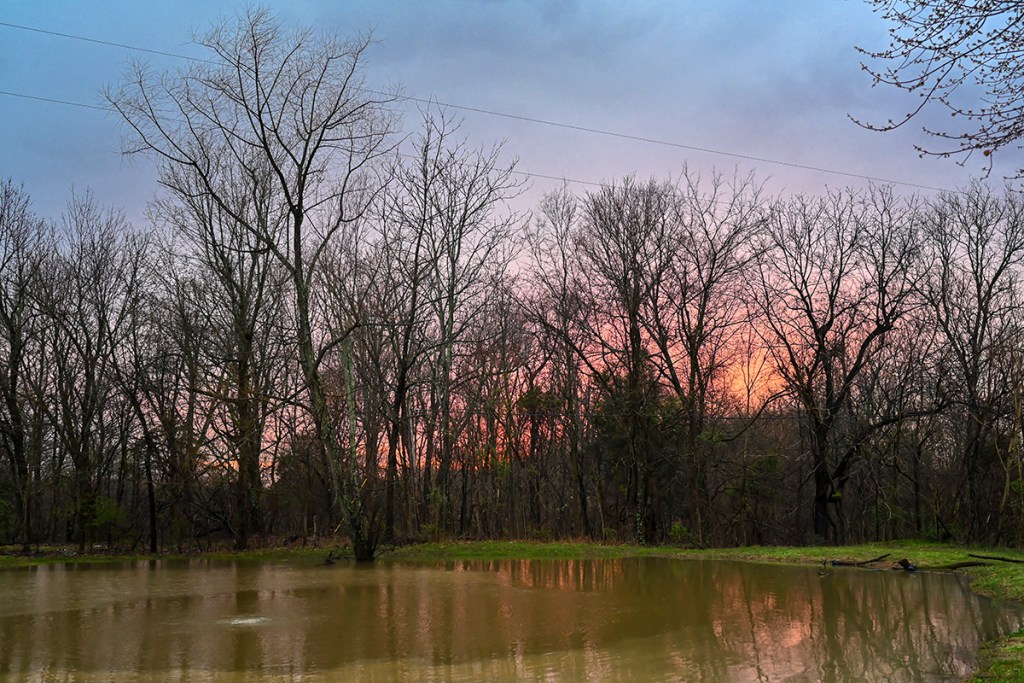
Because Mammoth Cave had suspended all underground tours, occupancy at the park was low — mostly overnighters heading north. We experienced torrential rain during our stay, and even with breaks in the weather the ground remained completely saturated. March in Kentucky can be unpredictable, and this visit was no exception.

The park owner, Eldon, was wonderfully friendly and a real pleasure to talk with. Jake the dog was in heaven — deer and squirrels ventured right to the edges of the campground, and he spent much of his time pressed against the motorhome windows, tail going nonstop.

After a long day of wildlife watching, Jake settled in with his nightly rawhide. He never eats the whole thing in one sitting — his ritual is to parade it around the motorhome and show it off to anyone who will pay attention before finally getting down to business.
Mammoth Cave National Park

Mammoth Cave National Park protects the longest known cave system on Earth, with more than 400 miles of surveyed passages — and geologists believe a great deal more remains to be mapped. The cave takes its name not from woolly mammoths but from the sheer scale of its chambers, some of which are vast enough to swallow entire city blocks. It was designated a UNESCO World Heritage Site in 1981 and an International Biosphere Reserve in 1990, recognizing both its geological importance and the extraordinary ecosystem it supports.
Human history in the cave stretches back roughly 4,000 years. Native Americans explored its passages extensively, mining selenite crystals, mirabilite, and other minerals by torchlight. During the War of 1812, the cave became a critical source of saltpeter — a key ingredient in gunpowder — and was mined extensively, largely by enslaved workers. One of the more remarkable chapters in its history came in the 1840s, when a physician named John Croghan brought tuberculosis patients underground, convinced the cave’s cool, stable air might cure them. The experiment failed tragically; several patients died inside the cave. The remains of the stone huts built for them can still be seen on certain tours today.

The cave is formed in thick limestone beneath a protective cap of sandstone. Over millions of years, slightly acidic groundwater dissolved the rock and carved the labyrinthine passages we know today. The cave maintains a constant temperature of around 54°F (12°C) year-round — cool and damp no matter what the weather is doing above ground. More than 200 species of animals have been documented in the cave system, including eyeless cave fish, eyeless cave crayfish, and the endangered Indiana bat, all evolved over millennia in the permanent darkness.

Even with the underground tours cancelled, the park roads and hiking trails remained open. The timing of our visit — mid-March — meant the forests were just beginning to wake up. Apple trees and daffodils were putting on a quiet show, bright against grey skies, while the hardwood forest around them was still largely bare. The heavy rains had made the trails too muddy for a comfortable hike, but simply driving the park roads and stopping at viewpoints gave us a genuine sense of how beautiful this landscape is.


The Mammoth Cave Baptist Church, established in 1827, stands quietly within the park boundaries — a reminder of the farming communities that once lived across this land. When the federal government moved to create the national park, eminent domain was used to acquire the last of the private holdings. Families were forced from property that had been in their hands for generations, and deep bitterness toward the park lingered in some communities for decades. It is a complicated history, worth understanding alongside the cave’s remarkable natural story. The park was officially dedicated in 1941.


The forest itself was extraordinary — the heavy rain had everything dripping and luminous. Moss carpeted every surface, and fungi of every shape clung to fallen logs and standing deadwood. After years of traveling through the American West, it was striking to be surrounded by this kind of lush, dense, eastern forest.

The Green River flows through the heart of the park, and the spring rains had pushed it well above its banks, creating a dramatic, coffee-colored torrent through the trees. The river is deeply intertwined with the cave system — its waters have shaped the underground landscape over millions of years and continue to flow through passages deep below the surface. Even swollen and muddy, it was beautiful in a raw, elemental way.

Throughout the park’s outer areas, abandoned farmhouses and old homes stand in varying states of decay — the quiet remnants of communities displaced when the national park was formed. This old travel trailer, slowly being absorbed by the forest, felt like a different kind of monument: to optimism, to journeys taken, and to the way time eventually reclaims everything. We will come back to Mammoth Cave when the tours are running. There are more than a dozen different cave experiences — from easy walking tours to full wild caving adventures — and we intend to experience them properly. This visit was just a preview of what we know will be an unforgettable place.
Practical Tips for Visiting Mammoth Cave National Park
Book your cave tour well in advance. This cannot be overstated — tours sell out weeks or even months ahead during summer and holiday weekends. Reserve through the NPS website as soon as your travel dates are confirmed. Arriving without a reservation during peak season may mean no cave access at all — as COVID proved to us in a different way, access is never guaranteed.
Dress in layers regardless of the season. The cave holds a constant temperature of approximately 54°F (12°C) year-round. No matter how warm it is outside, bring a light jacket or fleece — you will be glad you did, especially on longer tours.
Wear sturdy, closed-toe shoes. Cave floors are often wet and slippery, and many tours involve uneven terrain, low ceilings, or narrow passages. Good rubber-soled shoes are essential. Sandals and flip-flops are not permitted on cave tours.
Choose your tour based on your fitness level. Mammoth Cave offers a wide range of tours, from the gentle Historic Tour — mostly flat walking on paved paths — to the strenuous Wild Cave Tour, where you crawl through tight passages on your hands and knees wearing a helmet and headlamp. Read the descriptions carefully before booking, as some tours have significant physical requirements.
There is plenty to do above ground. The park has over 70 miles of surface hiking trails, the Green River for canoeing and fishing, and scenic drives through rolling Kentucky woodland. Even if cave tours are unavailable, the park is worth a visit on its own terms.
Check trail conditions before heading out. The Cave City area receives substantial rainfall, and trails can become extremely muddy after wet weather — as we discovered firsthand. The park’s visitor center staff can advise on current conditions.
Pets are not permitted inside the cave but are welcome on most surface trails and in campgrounds on leash. Jake the dog gave the above-ground experience his full approval, particularly the deer population at Singing Hills RV Park just down the road.
For more of our RV travels during the early COVID-19 pandemic, including our time in Nashville and heading south, see our previous post. And for another spectacular national park in the eastern United States, don’t miss our coverage of Great Smoky Mountains National Park.