Updated: September 13, 2026
Fifteen species of fish are native to the streams of the Black Hills. Not one of them is a trout. Every trout in every creek in these hills — and people drive across the country to fish them — was put here on purpose, and most of them came out of a low stone building a short walk from where we parked the trailer.

And the waterfall in that photograph was dry for seventy-two years. It is running again because a mining company put the water back in 1990. Spearfish is a town where almost nothing you are looking at is the way it arrived, and it is a great deal more interesting for it.
Spearfish, South Dakota

Spearfish sits at the northern edge of the Black Hills, right on Interstate 90 and close enough to Wyoming to see it. Fewer than 13,000 people live here. Locals told us the thing visitors say most often is “we had no idea it was so beautiful here,” and we said it too. On a map it looks like a highway town with a college in it.
We had only booked a couple of nights, which is an embarrassing amount of time to give this place. It was meant to be a layover on the way south from Medora and Theodore Roosevelt National Park, about four hours north, and a chance to get warranty work done on the truck at the local Ford dealer. We would like to have had a week. The downtown is a few walkable blocks of shops and restaurants and there is more to do within twenty miles than we got through in a month elsewhere.
Spearfish City Campground

What a find. Fifty-amp service, good water pressure and sewer, no wifi at all, and very large sites. Ours backed straight onto Spearfish Creek, which meant we went to sleep listening to it. The campground is city-run, sits inside the town rather than out on a highway, and has enough trail through it to get our daily walking done without driving anywhere.


There is a paved path along the creek behind the sites and it runs most of the way through town. Jake spent a good deal of the visit sitting and watching people go past, which is his favorite form of exercise. The apple blossoms at the top of this section were on that same trail.
Lunch at Killian’s

Full bar, friendly staff and a genuinely good lunch menu, a short walk from downtown. After a run of small-town restaurants that close at two, it was a pleasure.
Spearfish Canyon

The canyon runs about nineteen miles south from town along U.S. 14A, which is a designated scenic byway, and it is the reason most people come. The road climbs gradually the whole way with the creek beside it and walls above it, and Bridal Veil Falls comes down a sheer sixty-foot cliff close enough to the road that there is a viewing platform. It is the easiest waterfall in the Black Hills to see and one of the best.
A Canyon Cut Into an Ancient Reef
The walls here are Pahasapa limestone — the same rock geologists elsewhere call the Madison — laid down about 320 to 350 million years ago on the floor of a warm shallow sea that covered this part of the continent. What you are driving between is compressed sea bottom: the shells, corals and lime mud of an ocean that no longer exists anywhere. Above it in places sits the Minnelusa formation, tan and yellow sandstone from a bit later.
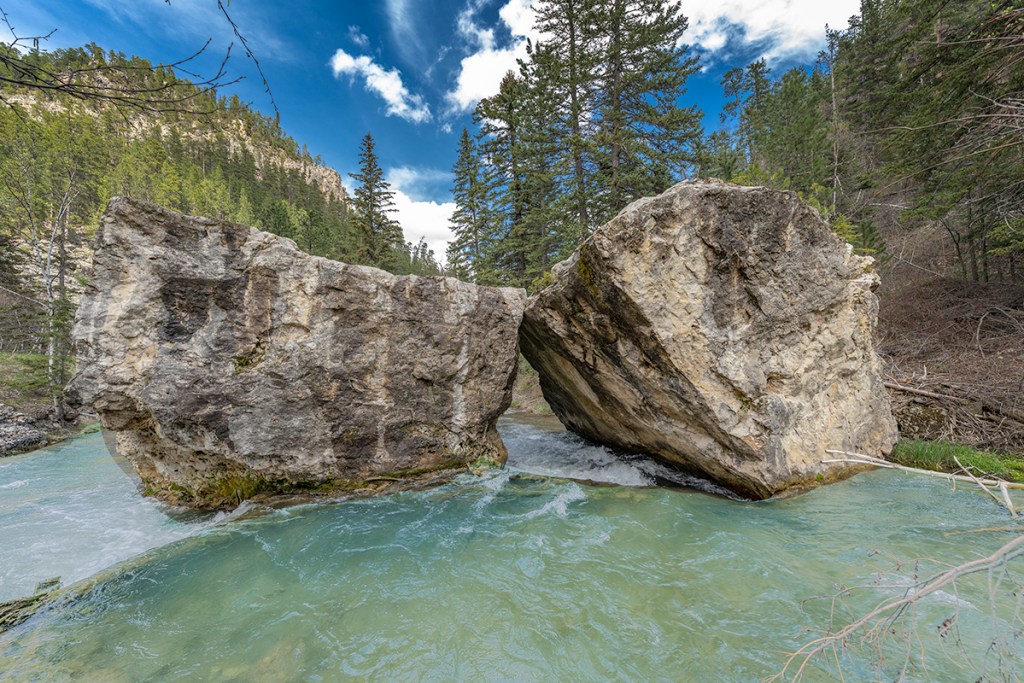
These are the Kissing Rocks, also called the Dice, sitting out in the middle of the creek. They are limestone blocks that came off the wall above and stopped where they landed, which is how most of the loose rock in this canyon got where it is.
Limestone dissolves in slightly acidic water, which is why the Black Hills are full of caves and why this canyon is a gorge rather than a valley — the creek cuts down faster than the walls fall back. The inner gorge is about a thousand feet deep and the whole thing has been cut in roughly five million years, which sounds like a long time until you remember the Badlands managed their entire existence in a tenth of that. Spearfish Creek also does the other thing limestone streams do: in places it goes underground and comes back. It is the same rock and the same chemistry as the boxwork passages at Wind Cave forty miles south, and the same story as Mammoth Cave a month behind us in Kentucky.
The Falls That Came Back

Spearfish Falls is a short walk down from the Latchstring at Savoy, and it is the prettiest thing in the canyon. It is also, for most of the twentieth century, a thing that did not exist.
The Homestake Mining Company at Lead needed electricity, and the creek was the cheapest way to get it. Hydro Plant 1 opened on April 12, 1912, fed by a dam at Maurice and eight tunnels drilled five miles through the canyon rock — six and a half feet wide, five feet high, cement-lined, dropping the water eight hundred feet to the turbines. Hydro Plant 2 followed in 1918, six miles up the canyon, and when it started it took the water that made Spearfish Falls. The falls went dry.
Plant 2 was wrecked by a canyon landslide in 1947 and never ran again, but the water stayed diverted anyway. Homestake did not re-channel the creek back over the falls until 1990. So this waterfall spent seventy-two years as a dry rock face, and every photograph of it taken before about 1918 and after 1990 shows the same thing, with three generations of nothing in between. Plant 1 is still turning, now owned by the City of Spearfish.
The creek gave this valley its irrigation, its electricity, its fishing and its hatchery, and all of that is true. It is worth saying plainly what it also cost: the same water that lit the mine took the waterfall away for the better part of a century, and nobody put it back until there was no longer any money in keeping it.
What We Missed
We turned around at Savoy, which we regret. Roughlock Falls is a short drive up Forest Road 222 from there and is the most photographed waterfall in the canyon, and the final winter scene of Dances with Wolves was filmed on that stretch of Little Spearfish Creek in 1990 — the same year the water came back to Spearfish Falls, as it happens. Carrying on south instead of turning takes you to Cheyenne Crossing and out the top of the canyon. Next time.
Lead, and the Hole That Turned Out to Be Worth More Empty
Twenty miles up the canyon road is Lead, and under Lead is the Homestake Mine. It ran from 1876 to 2001, went down about eight thousand feet, produced roughly 41 million ounces of gold and 9 million ounces of silver, and was the largest and deepest gold mine in North America. It is the mine that the Black Hills gold rush turned into, and the reason Deadwood next door survived when the other camps did not.
In the mid-1960s a Brookhaven chemist named Raymond Davis Jr. asked the mining company for a room 4,850 feet down, filled a tank with a hundred thousand gallons of dry-cleaning fluid, and spent the next thirty years counting argon atoms. He was counting neutrinos from the core of the sun, and he kept finding about a third of what the theory predicted. That discrepancy — the solar neutrino problem — turned out to mean neutrinos change type in flight, which meant they have mass — something the Standard Model of particle physics said they should not have. Davis won the Nobel Prize in 2002, the same year the last of the mine shut down.
He needed the depth because a mile of rock is the only shield thick enough to stop cosmic rays, which is the one thing a played-out mine has in abundance. South Dakota created a science authority in 2004, T. Denny Sanford put in $70 million in 2006, Barrick Gold donated the property, and the Sanford Underground Research Facility opened in 2007 in the same shafts. The LUX-ZEPLIN dark matter detector has been running down there since 2021 and has set the tightest limits yet on what dark matter can be, and crews finished hauling out more than 800,000 tons of rock in 2024 to make room for a neutrino experiment that will fire a beam at it from Illinois.
So the deepest hole anyone ever dug in this country looking for gold is now the quietest place in it, and that turns out to be the more valuable property. We did not get up to the visitor center, which was a mistake.
D.C. Booth Historic National Fish Hatchery


The hatchery is a short walk from the campground and we went every day, because there was something different happening every time. There is an underwater viewing window where the trout come right up to the glass, long outdoor raceways you can walk between, and a bucket of feed for a quarter that will start a riot.
The Trout That Were Never Here
This is the part worth knowing. Fifteen species of fish were native to Black Hills streams — chub, suckers, dace and their relations — and there was not a trout among them. Not one. The clear cold limestone-fed creeks that look like they were designed for trout had never held any.
Private attempts started early: trout may have gone in near Custer as early as 1886, and by 1890 brook trout were living in springs near Spearfish. In 1891 federal hatchery men from Leadville, Colorado, worked their way along the railroad between Edgemont and Deadwood putting in about ten thousand fish. Then Congress authorized a hatchery here in 1896, a scout picked this spot for its water, and after a hard winter delayed everything it opened in 1899.
DeWitt Clinton Booth came up from the Leadville hatchery to run it and arrived in late July 1899, just as the first shipment of blackspotted trout eggs did. Within days a flash flood came down the draw and killed all hundred thousand of them. He built storm channels. In 1904 another flood came and he built ten-foot bulkheads. He stayed thirty-four years, put up the superintendent’s house on the grounds in 1905, and it is still standing.
The numbers are the thing. The first release went out in April 1900 — twenty-five thousand blackspotted and brook trout into Little Spearfish and Whitewood creeks. By 1909 the hatchery was producing two million trout a year. Between 1899 and 1911 it distributed 23.2 million fish, and by 1915 the running total was 30.7 million: nineteen million blackspotted, nine and a half million brook, plus rainbow, German brown and cutthroat. Three-quarters of them stayed in the Black Hills. The fishery that this region is now known for was manufactured here, deliberately, over about fifteen years.
We keep running into this. The bison at Medora came up from Nebraska on a truck in 1956, the bighorn we photographed in Custer State Park descend from twenty-two sheep hauled out of Colorado in 1964 by way of the Badlands, and every wild turkey in the Black Hills descends from twenty-nine birds shipped up from New Mexico between 1948 and 1951. The trout are the same story told forty years earlier and by rail.
The Fish Cars

That is how they moved them. Before refrigerated trucks existed the Fish Commission ran purpose-built railroad fish cars — rolling aquariums with crews who lived aboard, aerating the water by hand and swapping it out at station stops. Ten of them served this hatchery over roughly sixty-six years. The car on the grounds is a reproduction, Fish Car No. 3, and behind it is a replica of the 1899 ice house, because keeping eggs and fish alive on a train meant cutting blocks of ice out of the creek in winter and stacking them in sawdust to last until summer.
The Grounds

The daffodils were still going when we were there, which tells you how late spring runs at this elevation. Beyond the ponds there is a museum in the original 1899 hatchery building, the Booth House furnished to about 1905, a boat, and an archive holding more than 185,000 fish-culture artifacts — the largest collection of its kind in the country, most of it in storage rather than on display.
The hatchery was closed in 1983 as a budget cut and reopened in 1989 in its present form, half working hatchery and half museum, which is why it has a volunteer society attached to it and a name that long. It still spawns and releases twenty to thirty thousand rainbow trout a year. Admission is free.
A Blue Jay and a Little Brown Bat


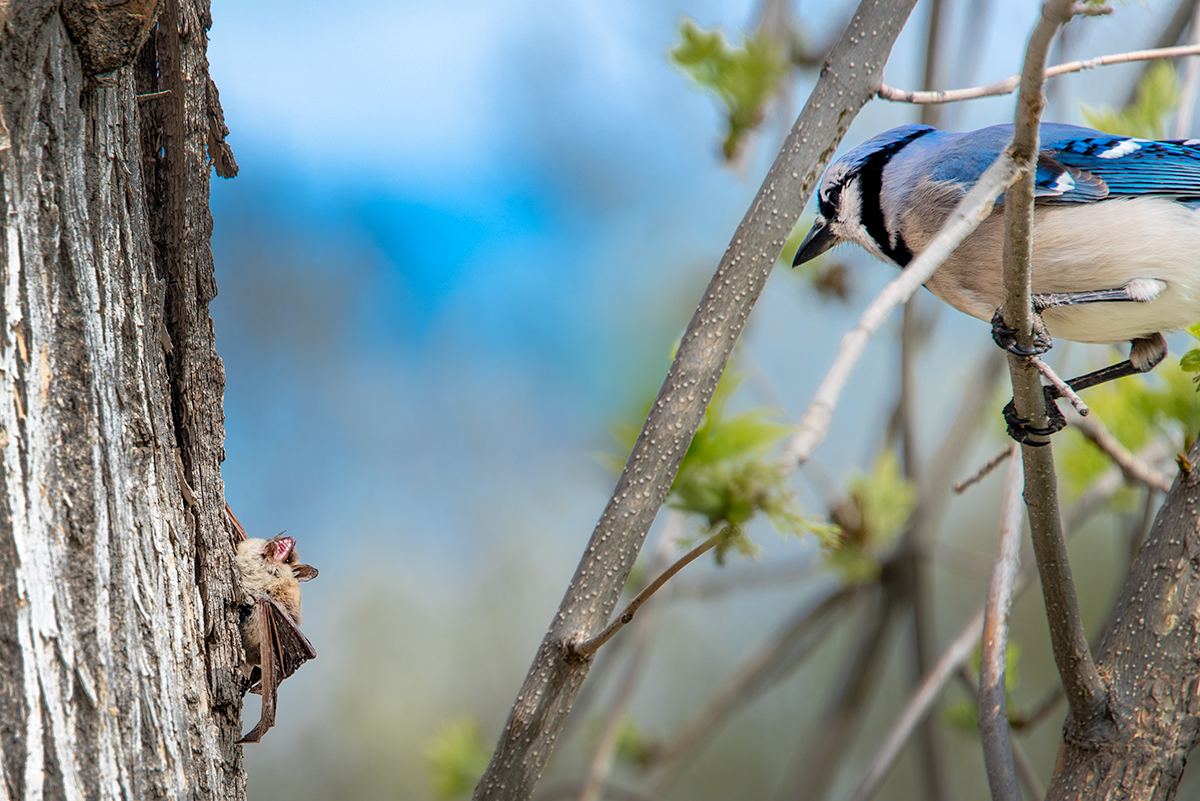
This was the strangest thing we saw all week. We were photographing a little brown bat roosting on a tree trunk when a blue jay came in and went after it. The bat was knocked down to the ground, where it sat for another photograph, and then it got away. It appeared unhurt.
Blue jays are corvids and they are not fussy. Most of what they eat is acorns and insects, but they take eggs, nestlings, small rodents and, occasionally, bats, and they will mob anything they read as a threat or an opportunity. A bat clinging to a trunk in daylight is both.
The bat is the one worth pausing on. Myotis lucifugus weighs about as much as two quarters, eats its own body weight in insects on a good night, and — astonishingly for something that size — can live thirty years. It hibernates in caves, which is where its trouble is. White-nose syndrome, a cold-loving fungus that wakes hibernating bats until they burn through their fat reserves and starve before spring, has killed more than ninety percent of the little brown bats in parts of eastern North America. It reached South Dakota in 2018, confirmed first at Badlands National Park and then at Jewel Cave, and biologists found it at Wind Cave in late 2019. We were standing in a canyon forty miles from both. The U.S. Fish and Wildlife Service has the species under review for federal listing.
Which is an odd thing to think about while watching a bird try to eat one.
Goslings


It was the middle of spring and the hatchery ponds were full of Canada geese with broods. Goslings are precocial — out of the egg with their eyes open, walking and feeding themselves within a day — but they stay with both parents for a full year, which is unusual among birds and is why a gosling this size is never on its own. Canada geese also mate for life and return to the water they hatched on, so the birds on these ponds are almost certainly the descendants of the birds that were on them last year.
Planning a Visit to Spearfish
Give it more than two nights. That is our main advice and it is born of regret. Between the canyon, the hatchery, Lead and the northern hills there is easily three or four days here, and Spearfish is a cheaper and quieter base than Deadwood or Keystone.
Drive the whole canyon. U.S. 14A runs nineteen miles from Spearfish to Cheyenne Crossing. Bridal Veil Falls is right beside the road; Spearfish Falls and Roughlock Falls are both reached from Savoy, Spearfish Falls by a short trail from the Latchstring and Roughlock by Forest Road 222. Do all three. The road is open year round and the canyon in autumn is supposed to be the best color in the state.
The hatchery is free and it is not a twenty-minute stop. Underwater viewing window, raceways, the fish car, the ice house, the Booth House and the museum. Bring quarters for the feed dispensers. It sits right beside the city campground, so if you are in an RV you can walk to it.
Spearfish City Campground has full hook-ups, big sites, creek frontage and no wifi, and it is inside the town rather than out beside the interstate. Book ahead in summer.
Lead is twenty minutes away and the Sanford Lab visitor center and the Homestake open cut are both there. We missed it and should not have.
Avoid the first full week of August, when the Sturgis rally is thirty miles east and fills every bed in the region. And if you are here in January, the town throws a small festival for the chinook — which needs explaining.
The Two Minutes That Made the Record Books
On the morning of January 22, 1943, at about half past seven, the temperature in Spearfish went from four below zero to forty-five above in two minutes. A chinook — a dry downslope wind off the Rockies that the Plains tribes called the snow eater — rolled over the town. Windows on houses and cars fogged instantly and several cracked from the shock. Drivers over toward Rapid City had to stop and scrape frost off the outside of their windshields. Guinness lists it as the fastest temperature change ever recorded anywhere on earth and it has stood for more than eighty years. Spearfish celebrates it every January, which is exactly the right response.
It is also the best single argument for the point this whole post keeps making: nothing here holds still.
Frequently Asked Questions
How long do you need in Spearfish? Two nights is not enough, which we know from experience. Three or four lets you drive the full canyon, do the hatchery properly, get up to Lead, and still have a morning spare. Many people treat Spearfish as a bed for Deadwood and Sturgis; it deserves better than that.
Is Spearfish Canyon worth driving? Yes, and it is easy — nineteen paved miles of U.S. 14A with the creek beside you the whole way, open all year, no tunnels and nothing that will trouble a large vehicle. Three waterfalls, thousand-foot limestone walls, and a designated scenic byway.
Which Spearfish Canyon waterfall is the best? Bridal Veil Falls is the easiest, a sixty-foot drop right beside the road with a platform. Spearfish Falls is the prettiest and takes a short walk down from the Latchstring at Savoy. Roughlock Falls is the most photographed and needs a short drive up Forest Road 222. See all three if you can.
Is the D.C. Booth fish hatchery worth visiting? Very much so, and it is free. Underwater viewing window, outdoor raceways you can feed, a railroad fish car, an ice house, the 1905 superintendent’s house and a museum holding the largest fish-culture collection in the country. Allow an hour or two, not twenty minutes.
Were there ever wild trout in the Black Hills? No. Fifteen fish species were native to these streams and none of them was a trout. Stocking began privately in the 1880s and the Spearfish hatchery industrialized it from 1899 — more than thirty million fish by 1915. Every trout you catch here descends from a fish somebody carried in.
Can you tour the Sanford Underground Research Facility? Not the underground levels, which are a working laboratory a mile down, but the Sanford Lab Homestake Visitor Center in Lead is open to the public and looks out over the open cut. Twenty minutes from Spearfish.
When is the best time to visit Spearfish? Late spring through early autumn. We were there in spring with the apple blossoms and daffodils still out and the goslings on the water, which was lovely and quiet. Autumn in the canyon is the local favorite. Avoid the first full week of August, when the Sturgis rally is thirty miles away.
Next Stop
From Spearfish we crossed into Wyoming and on to Buffalo and the Bighorn Mountains — out of the Black Hills at last and into real mountains.